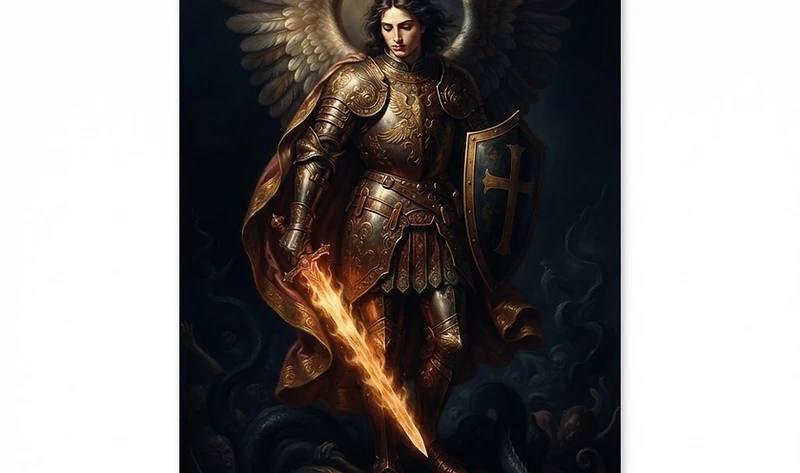
The Life of the Archangel
He is not a saint canonized by men, but an immortal spirit — a Prince of the Nine Choirs whom God has set as sentinel over his Church. Trace his passage through Scripture, through the rock of Mount Gargano, and into the prayer of every century since.
The Name That Scatters the Rebel
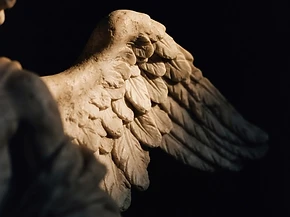
The very name 'Michael' — Quis ut Deus? — 'Who is like God?' — is a cry of the faithful against the pride that would make a god of the creature. In the iconography of the Church it is the battle cry that shattered the morning star's revolt; in the liturgy it is the constant answer to every seduction of the world. The Archangel is named not for what he is, but for what he proclaims: there is none like the Lord.
The Prince of the Heavenly Host
Saint Michael appears throughout Scripture as the champion of God's people. He is the one who, with his angels, wages war against the dragon (Revelation 12:7-9). He is spoken of in Daniel (12:1) as the great prince who rises in defense of the people of God. In the Letter of Jude (v.9) he is named as the one who, in contending with the devil for the body of Moses, did not presume but said, 'The Lord rebuke you.' He is the unnamed messenger of the Annunciation to the shepherds, the strengthener of Christ in agony, the herald of the Resurrection and of the Ascension, the bearer of the tidings of glory.

The Apparition at Mount Gargano
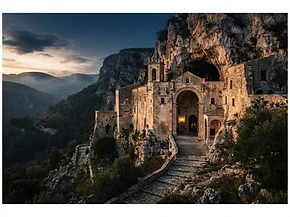
On the rugged heights of Mount Gargano in southern Italy, the Archangel made himself known in a manner the Church has never forgotten. A bull, wandering into a hidden cave, refused to leave; an archer's arrow loosed at it returned to wound the archer himself. Three times the cave appeared inviolable until Saint Michael declared to the bishop of Siponto that the place needed no consecration by human hands — 'Where the rocks are cleft open, there I have myself chosen to be worshipped. I am the guardian of the place and will watch over all who come in faith.' The Sanctuary of Monte Sant'Angelo stands there to this day, one of the oldest places of Christian pilgrimage in the West.

The Defender of the Church and of the Faithful
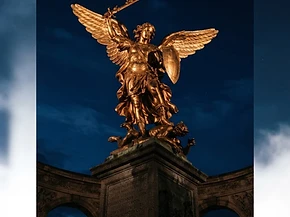
Devotion to Saint Michael spread through Europe with the conversion of the barbarian peoples. The Lombards, the Normans, and the Franks carried his banner before them; the sixth-century apparition at Gargano and the later apparition in France on the mountain that became Mont-Saint-Michel fixed his image in the heart of medieval Christendom. He was invoked as the patron of the dying, the protector of cemeteries, the weigher of souls in the balance of divine justice, and the heavenly model of the Christian knight.

Pope Leo XIII and the Universal Prayer
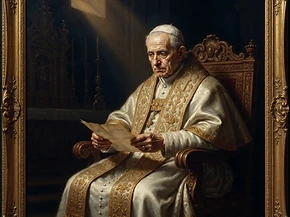
In 1884, after a vision of evil spirits gathering over the city of Rome, Pope Leo XIII composed the prayer to Saint Michael the Archangel and ordered it to be recited at the end of every Low Mass throughout the Church. For more than three quarters of a century the Leonine Prayer echoed in every Catholic church in the world, weaving the Archangel's name into the daily liturgy of the faithful. Leo XIII attached to the recitation a partial indulgence, available to all who, in reverence, would call upon the Prince of the Heavenly Host.

Patron of Those who Serve and Protect
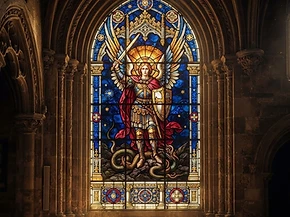
Saint John Paul II urged the faithful to take up the Leonine Prayer anew. In our time Saint Michael is invoked as patron of police officers, of soldiers, of paramedics and parachutists, of those who face the powers of the world and the unseen. He remains, above all, the patron of the Universal Church and the model of the supernatural combat that every soul must wage. He is no faded emblem of a bygone age but the living protector the Church entrusts with her final, daily cry: 'Lead us not into temptation, but deliver us from evil.'
Continue your pilgrimage
Having traced his story, take up his chaplet — the devotion he himself asked to be prayed.
Pray the Chaplet